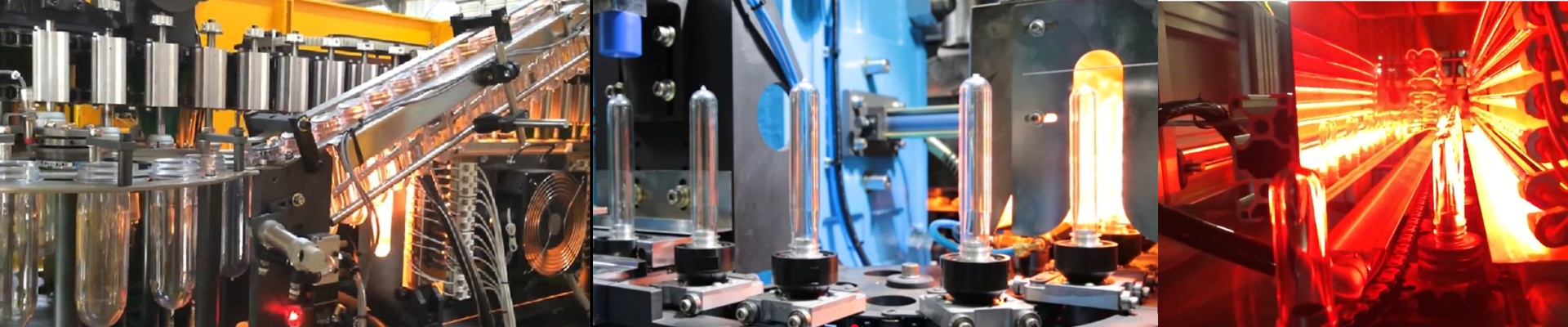
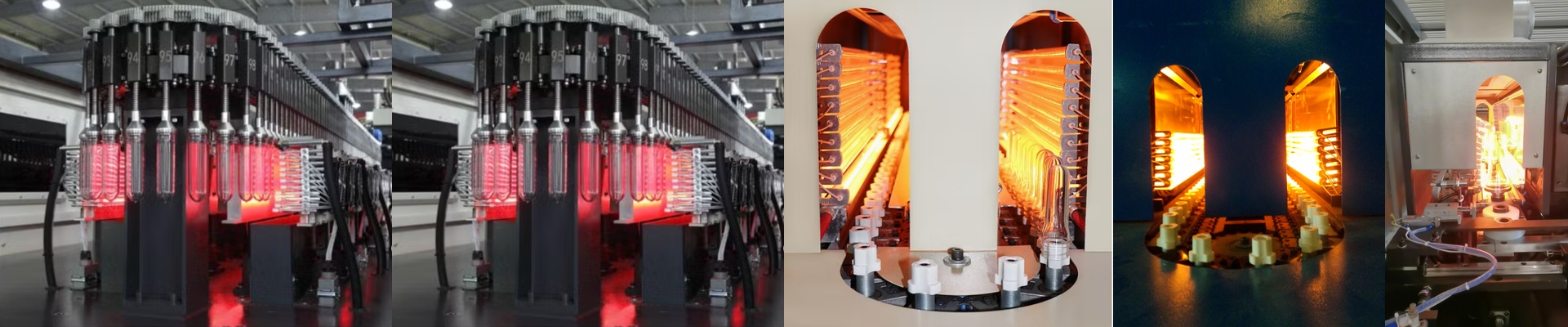

On the plant floor, the blow molder’s heating tunnel is where the whole cycle kicks off. If preforms run cold or temperatures start drifting, you know it right away—stretch marks, uneven wall thickness, and scrap piling up. The heater lamp and its control are the first line of defense.
What matters, technically
Most blow molding infrared heaters are short-wave halogen or quartz emitters, chosen for fast response and tight focus. You’ll typically see 1200W to 2400W ratings at 120V or 230V, with R7s bases and compact filament lengths that match the heating zone geometry. The solid state relay (SSR) is what makes those specs practical. It switches the lamp using zero-crossing or phase-angle control, depending on your PLC output and the heater controller strategy. For you, that translates to repeatable power delivery cycle after cycle—without the contact bounce and wear you get from mechanical contactors. We match the SSR to the lamp: current rating with margin for inrush, the right voltage class for the line, and a control voltage that lines up with your machine’s I/O.
Why this pairing works
In stretch blow molding, preform heating has to hold steady inside a narrow band before the stretch rod and blow pins move. Pairing an SSR with the right infrared lamp gives you faster settling, less overshoot, and more consistent preform stretch behavior. That shows up as fewer rejects, more uptime, and a process window you can count on. Energy use drops because the lamp heats on demand and holds setpoint without wide cycling. On Sidel, Krones, SIPA, Husky, SACMI, and Nissei ASB machines, the gain is real when the lamp, SSR, and controller are treated as a matched system—not swapped out piecemeal.
The details that bite you
Installation is straightforward, but the shop-floor details make or break it. Confirm the lamp’s wattage, voltage, base, and length against the heating zone’s reflector and clearance. Spec the SSR with enough current headroom—lamps pull heavy inrush when they’re cold. Mount the SSR with proper heatsinking, keep the wiring tight, and protect the control side from electrical noise. Pay attention to thermal management inside the tunnel. Clean reflectors and correct airflow prevent hot spots and stretch lamp life. You can expect strong performance, but verify local mains voltage stability—big line swings can push components outside their design window.